
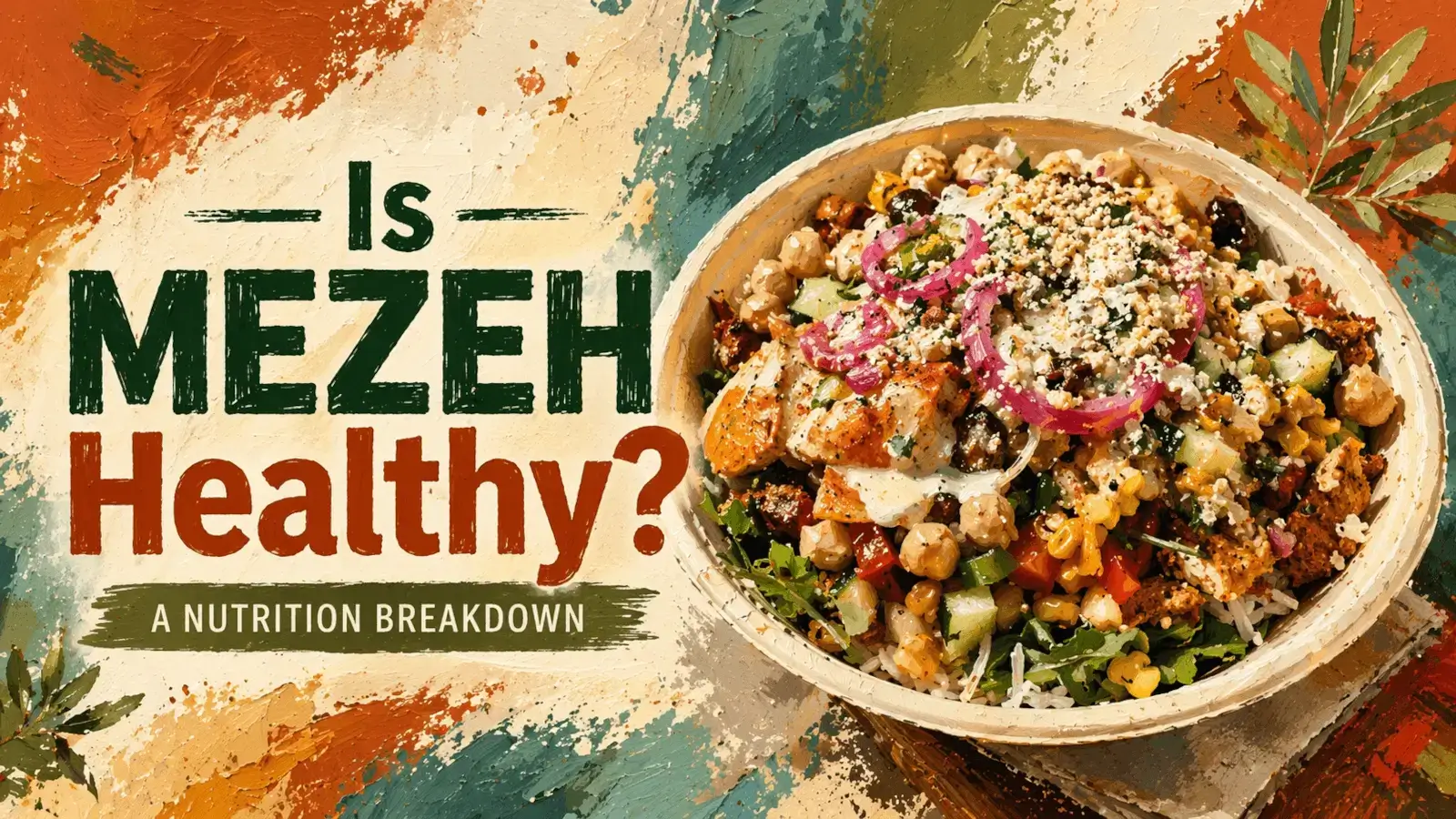
Mezeh is a Mediterranean fast-casual chain that lets you build grain bowls, salad bowls, and wraps from scratch-made ingredients. Olive oil is the primary fat across the menu, proteins are grilled rather than fried, and there are no artificial additives or preservatives in any of the dishes.
That does not mean every order is automatically a good one. Grain bowls can push past 1,000 calories, and sodium counts on some builds are high. Whether Mezeh is healthy for you comes down to what you order and what you're trying to accomplish.
What Mezeh Gets Right
The foundation of the menu is sound. Bases like brown basmati rice and bulgur pilaf are whole grains. The greens options include romaine, power greens, and mixed greens, all low in calories and high in fiber. Proteins are grilled and seasoned simply without heavy breading or frying.
The topping selection is where Mezeh pulls ahead of most comparable chains. Tabbouleh, sumac cucumbers, pickled turnips, roasted vegetables, and fresh herbs add fiber, micronutrients, and volume without meaningfully increasing calorie counts. These are additions you can load up on freely.
Mezeh also uses extra virgin olive oil as its primary cooking fat, which is associated with heart health and anti-inflammatory effects. That distinction matters compared to chains using seed oils or partially hydrogenated fats.
Where Mezeh Gets Complicated
The grain bowls are calorie-dense. The Mezeh Classic comes in at 870 calories, the Falafel Classic at 1,170, and the Power Steak at 1,180. If you're not paying attention to the numbers, it's easy to finish a bowl that covers more than half a day's worth of calories.
Sodium accumulates quickly. Several grain bowl builds exceed 1,500mg, and some push past 1,900mg — close to the American Heart Association's daily limit of 2,300mg. Most of it comes from the proteins, hummus, and pickled toppings rather than any one ingredient.
Falafel is another item that surprises people. It reads as a plant-based, health-forward choice, and it is high in fiber and plant protein. But a full serving runs around 500 calories. That changes the math if you're expecting a lighter meal.
How the Proteins Compare
Protein choice is the single biggest lever in your build. The options vary more than most people realize.
Chicken shawarma is 130 calories and 21g of protein per serving — the most calorie-efficient protein on the menu. It's grilled with Mediterranean spices and no added breading. For people watching calories, it's the default pick.
Chicken kebab is a similar calorie and protein count to shawarma, with a slightly different spice profile. Both are strong choices and can be used interchangeably for macro purposes.
Steak runs higher in calories but delivers 26g of protein and is one of the most satiating options on the menu. If you're building a higher-calorie day and want maximum protein, steak and chicken shawarma are the two best anchors.
Shredded lamb is flavorful and high in protein at around 27g per serving, but it also carries more fat than the chicken options. It's a better fit for a mixed or grain bowl than a salad bowl where you're trying to stay light.
Falafel sits at roughly 500 calories for a full serving and is the highest-calorie protein option despite being plant-based. The fiber content is high and the protein is decent, but it's a meal in itself before you add a base or toppings.
How Different Bowl Formats Compare
Mezeh organizes its pre-built bowls into three formats: grain bowls, salad bowls, and mixed bowls. The format sets the calorie floor before any customization.
Grain bowls start with brown basmati rice or bulgur pilaf and run 870 to 1,180 calories for the pre-built versions. These are built for appetite and work better as a fuel meal around physical activity than as an everyday lighter lunch.
Salad bowls start with greens and are the lighter option. The Balsamic Chicken is 480 calories with 32g of protein. The Low Carb Crunch is 500 calories with 29g. The Mezeh Greek comes in at 590 calories and 32g of protein. These are among the better fast-casual options if you're keeping calories in check.
Mixed bowls combine grains and greens and land somewhere in the middle. The California Chicken is 650 calories with 29g of protein. The Harissa Chicken is 890 calories and 49g of protein, making it a strong high-protein build for bigger appetites.
Ingredients Worth Paying Attention To
Hummus contributes around 100 calories and 8g of fat per serving. Added to an already substantial grain bowl, it pushes totals up quickly. A smaller scoop rather than a full serving keeps the nutrition benefits without the calorie cost.
Tahini sauce runs around 90 calories per serving, and a heavy pour gets closer to 150 to 180 calories. Worth moderating if you're building a lighter bowl.
Pickled toppings like sumac cucumbers and pickled turnips are low in calories and add brightness and volume. Load up freely.
Fresh pita comes with most bowl orders at around 230 calories and 41g of carbs. If you're eating it alongside a grain bowl, that's a substantial carbohydrate stack. Half a pita or skipping it entirely is the easiest way to trim 100 to 115 calories from any build.
Is Mezeh Whole30 Compatible?
Mezeh is one of the easier fast-casual chains to navigate on Whole30. Most proteins, roasted vegetables, and toppings fit the program. The items to avoid are the pita and bulgur pilaf (grains), hummus (legumes), and any dairy-based sauces.
The most Whole30-friendly build is a greens base with chicken shawarma or steak, loaded with vegetable toppings like Turkish salad, sumac cucumbers, roasted vegetables, and pickled turnips, with lemon garlic sauce or harissa on the side. It's a filling and complete meal that fits the framework without much compromise.
A Reasonable Way to Order
For most people, a salad bowl or mixed bowl with chicken shawarma or steak, a moderate amount of hummus, and heavy on the vegetable toppings is a nutritious meal. It delivers fiber, lean protein, healthy fats, and a wide range of micronutrients from the toppings.
The grain bowls are not unhealthy, but the calorie counts are built for appetite. If you order one, skip the pita or eat half, go lighter on hummus and tahini, and treat it as a more substantial meal rather than a quick lunch.
Mezeh gives you enough flexibility to build something that fits almost any approach to eating. The ingredient quality is high and the customization is genuine. The catch is that the pre-built grain bowls are built for appetite, not calorie control, and the numbers can get away from you without much effort.
Want to see exactly what your Mezeh order adds up to? Build your bowl with the Mezeh nutrition calculator and see the full breakdown before you go.